
It can feel strange to want the sound of running water in a state that keeps asking everyone to use less of it. A waterfall can use less water than the lawn it replaces, and the rain that lands on your roof can water the rest of the yard.
You’ll learn:
- How the waterfall holds and reuses its water
- How its water use compares to a patch of grass
- What rainwater harvesting adds to a yard
- What went into one hillside waterfall and rainwater harvesting system
- What upkeep looks like, and when to plan the rainwater side of a build
How Does a Pondless Waterfall Hold and Reuse Its Water?
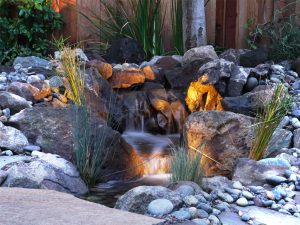
A pondless waterfall is built with a basin at the bottom that holds the water and the pump, along with AquaBlox, which create the empty space the water fills. You see rock and moving water, and the water you don’t see is underground, running through the same loop again and again.

Why Does a Pondless Waterfall Use Less Water Than Grass?
It recirculates its water, so the same water goes around again and again. The only water loss is evaporation, unless you have an issue like a leak.
A pondless waterfall taking up the same square footage as grass in the backyard uses less water.
Can Rain From My Roof Be Put to Work in the Yard?
Yes. We build rainwater harvest systems that let you use your rainwater for landscaping. One version we do puts an underground water tank beneath permeable pavers, like under a driveway, fed by the downspouts on the side of your house. EBMUD, the water company for much of the East Bay, says harvested rainwater reduces the need for supplemental irrigation.

What Went Into a Rainwater Harvesting System on a Pondless Waterfall in Oakland Hills?
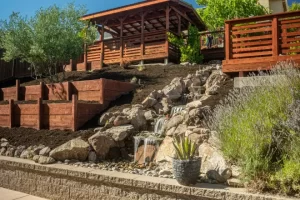
We paired a waterfall with a rainwater harvesting system on a hillside property in Oakland Hills. The waterfall is 22 feet long and winds alongside the homeowner’s staircase, so you walk beside the water on your way down to the lower yard.
The build took 4 weeks, and access to the backyard was extremely tight, which made it hard to get an excavator back there. We still set boulders of 400 pounds and up with one.
Our pondless waterfall and rainwater harvesting system in Oakland Hills has the whole story.
The harvesting side is all underground. We excavated a cistern 5.5 feet by 18 feet by 4.5 feet and lined it with AquaBlox and a liner. We installed 3 downspout filters to collect water from the roof’s downspouts. A 3/4-horsepower irrigation booster pump and an automatic fill valve connect to the water line, and an Aquasurge pump is the main pump.
The homeowner wanted a slower, babbling brook style of waterfall, so we built it along with the grade and kept the water slow-moving. Keeping it slow on that grade was all in the excavation, which is the bones of the build.
We also sent the flow to 3 places, including a boulder the homeowner already had, which we core-drilled into a bubbling boulder at the top. Splitting it that way kept the water from concentrating in one area.

How Much Upkeep Does a Pondless Waterfall Need?
It’s very simple. If debris falls into the waterfall, it’s typically easiest to turn it off for 24 hours and then blow it all out with a leaf blower, which takes around 30 seconds.
We also come by to do annual cleanouts on waterfalls. For a pondless waterfall, that’s either annually or twice a year, and we drain it completely and power wash it.

When Should You Plan the Rainwater Side of a Waterfall?
Early. On the Oakland Hills job, the harvest system came off the homeowner’s downspouts and was one of the first things we did. Other contractors were remodeling the house at the same time, so we worked their design and ours together and made sure our downspouts were placed correctly before they finished the exterior.
Want to See What Your Yard Could Hold?
If you’re thinking about trading some lawn for moving water, our pondless waterfall construction page shows how we build them.