

Most of your pool’s equipment sits out of sight on the equipment pad, yet you’ll notice its effects every time you swim and every time the gas bill comes.
You’ll learn:
- Who picks the equipment for your remodel
- What saltwater and chlorine each give you
- How a hybrid heat pump heats a pool
- What one control panel can run
- What happens with the equipment when the work is done
Who Picks the Equipment on My Pool Remodel?

You make the final pick from options we lay out for you. Your remodel might be only the pool, or it might grow into the whole backyard, with a spa, a waterfall, or an automatic cover. Either way, the equipment is part of the plan.
To make those options worth having, we try the newest equipment and learn how it works, so we can tell which fits each project best. That’s why we keep going to trainings and seminars to stay on top of the latest technology.
Should My Pool Be Saltwater or Chlorine?
Either one can work for your pool, and it comes down to which trade-offs you’d rather live with. Both kinds of pool use chlorine to keep the water clean, but the difference is whether you add the chlorine or the pool makes its own from salt.
Saltwater
A saltwater pool uses a salt chlorine generator, which turns the salt in the water into small amounts of chlorine throughout the day.
Here are the main pros and cons:
- It’s gentler on skin, eyes, and swimsuits.
- Your chemical costs are lower because you usually won’t need to add chlorine yourself.
- It costs more upfront because the salt chlorine generator is an added piece of equipment.
- It needs maintenance because if the salt cell inside the generator gets too clogged, it won’t work properly.
- The generator doesn’t perform well in the cold, and it shuts itself off if the temperature drops too low.
Chlorine
With a traditional chlorine pool, you add the chlorine yourself.
- It has a low initial cost.
- Other than adding the chlorine, it needs nearly no maintenance.
- It’s best suited for colder climates, where a salt chlorine generator can shut itself off.
How Can I Heat My Pool Without a Big Gas Bill?
One option is a hybrid heat pump, which can save a lot of gas by heating the pool on its electric side.
It can run as a gas heater, or it can use the air around it, like an air conditioner running in reverse, to heat the pool. It picks between gas and electric on its own, based on the air temperature and how warm you want the pool to be.

On the new pool we built as part of our pool and backyard renovation in Alamo, the homeowners chose a hybrid heat pump that heats with the surrounding air. With this heater, keeping the pool at a set temperature all season costs less to run than heating it up each time you want to swim, even if you only swim once a week or even once a month.
They also wanted an automatic cover because big trees surround the yard and they didn’t want to keep up with the maintenance. The cover holds the heat in, too.
Together, the hybrid heat pump and the automatic cover were a great idea, and the pair should save the homeowners a lot in gas over the years.
Can My Pool and Backyard Run From One Control Panel?
Your pool and backyard can run from one control panel. Nearly all of our pools get a control panel for the pool equipment, most often a Pentair, then a Jandy. We don’t install any other brand of pool automation.
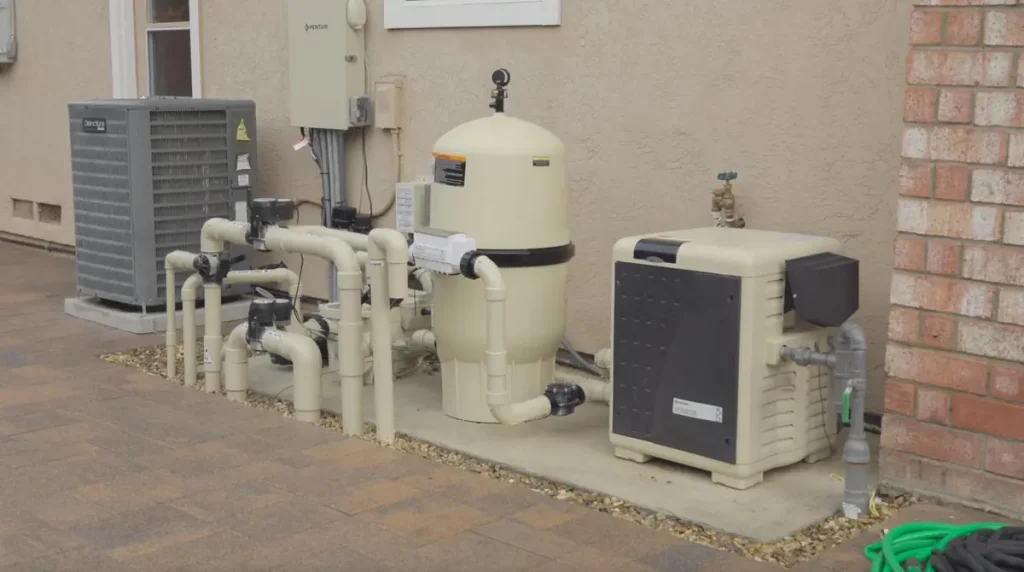
That same panel can also run your landscape lights and other things in the backyard that just turn on and off.
What Happens With My New Equipment When the Remodel Is Done?
Say the work is done, and you’re looking at a set of equipment you’ve never run. There are 2 things to take care of: the warranties and how it all runs.
Warranties vary quite a bit between the products we install. A pool pump, for example, can come with a 3-year warranty. For each one, we help you get set up with the warranty cards and everything you need to sign up.
On that same Alamo pool, we came out when the work was done to explain the system to the homeowners. We set the programming to their preferences and to what costs the least to run with the equipment they chose.
On that same pool, we set the variable-speed pump to run at a lower speed for a longer time to use less energy. That’s the opposite of how older pumps were set. ENERGY STAR says that cutting a pump’s speed in half lets it use just 1/8 as much energy. In California, a replacement pool pump motor of half a horsepower or more, made on or after July 19, 2021, has to be variable-speed, according to the California Energy Commission.
Ready to Plan Your Pool Equipment With California Aqua Pros?
When you’re ready to plan your pool remodel, we’ll walk you through the options for your water, your heat, and your controls.
Fill out our contact form or give us a call.